

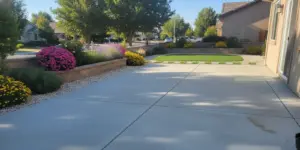
 A concrete patio sealer decision should begin with the slab, not a product label. Concrete condition, prior treatments, surface finish, water behavior, and intended use all affect what preparation and product may be appropriate. Sealer is not a repair for cracks or a substitute for drainage work. This guide gives homeowners a practical way to assess the surface, compare broad product categories, plan a careful application, and maintain the patio without relying on blanket promises.
What does a concrete patio sealer do?
Concrete is porous, and products sold as sealers are intended to change how the surface responds to moisture or other exposures. Some are designed to penetrate near-surface pores; others create a layer on the surface. Some aim to leave little visible change, while others can alter sheen, color depth, or the way a decorative finish reads. The name of a category does not establish how a particular product will perform on a particular slab. Read the actual manufacturer’s technical information and intended-use directions.
Before considering products, decide what you want the treatment to accomplish. Is the main concern how water interacts with the concrete, the appearance of a colored or stamped surface, or protecting a frequently used area from ordinary exposure? Are you comfortable with a visible coating, or do you want the surface to look much as it does now? How much ongoing inspection and cleaning can you realistically do? These questions narrow the conversation without implying that a sealer can solve every surface problem.
A sealer does not make weak concrete sound, repair cracks, correct settlement, stop standing water, or ensure that stains will never occur. It does not eliminate cleaning. If the patio has damage, poor drainage, an unknown previous coating, or a decorative finish, those conditions should be considered before applying anything. The product label and technical sheet govern preparation, use, and aftercare; generic advice cannot replace them.
What should you inspect before choosing a product?
Walk the entire patio in good light and make notes before deciding what to buy. Look beyond the most noticeable patch. Record the finish, the condition of the edges and joints, and any spots that collect water or remain shaded. Note whether the slab is plain concrete, colored, stamped, or otherwise decorative. A treatment that appears subtle on one finish may noticeably alter another.
- Surface condition: Look for loose or flaking material, worn traffic paths, residue, patches, visible cracks, and areas with a different texture. Note approximate size and location; do not assume that applying sealer is a repair.
- Water behavior: Observe rain or cleaning water. Where does it run? Does it linger in low spots? Do sprinklers or roof runoff repeatedly wet one edge? These observations can point to a separate drainage or irrigation question.
- Prior treatments: Ask household members or previous owners whether anything was applied. Save a product label or receipt if available. If the treatment is unknown, say so rather than guessing; residue may influence compatibility and preparation.
- Pattern and color: Note whether the slab includes pigment, stamped texture, exposed aggregate, repairs, or decorative borders. Consider how much variation is acceptable if a new treatment changes color depth or sheen.
- Everyday use: Think about foot traffic, pets, furniture, planters, cooking, shade, sun, and cleaning habits. The details help frame a product discussion but do not by themselves select a product.
- Nearby areas: Identify doors, painted surfaces, plants, drains, and adjacent paths that need protection from cleaning or application materials.
Separate surface concerns from the surrounding outdoor plan. If water from a bed or roof repeatedly reaches the slab, the source may matter as much as the concrete treatment. If the patio is one part of a larger improvement, consider how paths, planting, and hardscaping meet. California Landscaping DP describes landscaping and related outdoor improvements in its service information; the appropriate scope depends on the property and the work requested.
How can you turn an inspection into a useful plan?
A short written record makes it easier to compare advice and avoid overlooking a condition. Use a phone note or a simple page divided into four columns: observation, location, question, and follow-up. For example, “water remains near the back step after rinsing” is more useful than “patio gets wet.” “Unknown glossy layer on the shaded corner” is more useful than assuming the surface is untreated. Photographing the same locations in consistent light can help you track changes, but photos do not diagnose the cause.
Map the patio into zones if exposures differ. A section beneath a tree may collect leaves and stay shaded; an open edge may receive strong sun; an area beside irrigation may get repeated spray. Mark joints, repairs, and areas that are difficult to access. This prevents a product conversation from treating a mixed-condition slab as if every part were identical. A professional assessing the project can use those observations to explain whether one approach makes sense across the full surface or whether more evaluation is needed.
Write down the desired result in plain language. Examples include “keep the current color close to what it is,” “avoid a conspicuous glossy look,” or “understand whether a color-enhancing finish is suitable for this stamped pattern.” These are preferences, not performance specifications. Ask how a candidate product could affect them, and whether a sample area can be reviewed under the manufacturer’s directions before treating the full patio.
Also list what the sealer is not expected to do. If there is a crack, a low spot, or a mark that may be related to a previous spill, identify it separately. That keeps the scope honest: sealing, cleaning, repair, and drainage adjustments are distinct questions, even if they arise in the same outdoor project. A clear list of inclusions and exclusions is more useful than a broad promise about a finished appearance.
How should concrete be prepared for sealing?
Preparation is the process of making the surface suitable for the selected product. It is not simply rinsing away visible dirt. The exact steps depend on product instructions, the concrete finish and condition, weather, and prior treatment. Manufacturer directions for the actual product should govern. Ask whoever will do the work to connect each proposed preparation step to an observed condition on the patio.
1. Clear and protect the work area
Move furniture, mats, pots, and other items so the surface can be inspected and reached. Identify fragile planting, painted trim, thresholds, drains, and other nearby features. Agree how they will be protected during cleaning and application, and how runoff will be managed. Keep children and pets away from the work area when the product label or work plan requires it. Do not move items back until the stated access and cure instructions allow it.
Mark joints, cracks, edges, and drains before work starts. Discuss which areas should remain open or receive separate attention. Do not assume every joint should be filled or coated; joints may have a function, and treatment depends on their construction and the scope. If planters or furniture cannot be moved permanently, discuss how the contractor will reach the areas beneath them and what aftercare will be needed there.
2. Select cleaning methods for the surface
Sweeping may remove grit and loose leaves, but other contamination can require a product-specific cleaning approach. Grease, organic debris, mineral deposits, old coatings, and cleaner residue are different problems. An aggressive cleaner or mechanical method may change texture or damage a decorative surface. Ask what the suspected material is, how it will be addressed, and how surrounding plants and drains will be protected.
Do not combine cleaning chemicals or improvise a treatment. Follow the cleaner label and the sealer maker’s preparation guidance. A previous coating may not come off with ordinary washing. The person planning the work should determine whether the old layer is compatible, needs removal, or makes a proposed product unsuitable. A generic claim that all residue can be washed away is not enough; the surface and the product instructions should drive the plan.
3. Confirm drying requirements
Many products specify conditions for surface moisture. Drying time varies with cleaning method, temperature, shade, airflow, and the concrete itself. A slab that looks dry may still not meet a product’s requirements. Ask how the applicator will check readiness and what happens if rain, irrigation, or a schedule change interrupts the plan. The answer should refer to product guidance, not an assumed waiting period that applies to every product.
4. Address repairs and uncertain areas separately
If the patio has repairs or visible damage, clarify whether evaluation or repair is included, and whether the proposed sealer is appropriate over those areas. A patch can differ from surrounding concrete in color and absorption. Applying a product over it may not make the difference disappear. If compatibility or appearance is uncertain, ask whether a test area is suitable and where it can be placed without creating an objectionable mark.
Agree on what a test can and cannot tell you. It may help show color, sheen, or immediate compatibility in a limited area. It cannot guarantee that every part of a varied slab will look uniform or predict every long-term outcome. Review the patch after the time and conditions specified by the manufacturer. Consider it from ordinary viewing positions and in the light in which the patio is normally used.
5. Complete a readiness check
Before application, confirm that the surface meets the product’s requirements for cleanliness, dryness, condition, and temperature. Confirm that access, protection, and weather plans are settled. Ask what conditions would cause the crew to pause instead of proceeding. A decision to wait can be part of a sound plan when site conditions do not fit product directions.
A useful readiness checklist is simple: the chosen product and current instructions are available; prior treatments have been discussed; the surface has been prepared as specified; the weather and moisture conditions meet the requirements; adjacent features are protected; and household members know when the patio can be used again. If any answer is unclear, resolve it before work begins.
Which sealer categories are worth comparing?
Product labels and formulations vary. The table below is a general comparison to support questions, not a product recommendation. Ask how a specific candidate fits the actual slab, exposure, appearance preference, and maintenance expectations. The manufacturer’s current documentation is the source for that product’s intended use and limitations.
| Broad category | General approach | Appearance questions | What to verify |
|---|---|---|---|
| Penetrating sealer | Designed to enter near-surface pores rather than create a prominent film | May be considered when a lower-change appearance is desired; concrete and formulation affect the result | Intended exposure, preparation, substrate limits, and maintenance instructions |
| Film-forming sealer | Creates a layer at the surface | May alter sheen or visual depth; texture and application influence how it looks | Compatibility with existing treatment, surface feel, wear, and care directions |
| Decorative or color-enhancing product | May be formulated to complement or emphasize a decorative finish | Can change how pigment or stamped patterns appear; a sample may help set expectations | Suitability for the specific finish, test area guidance, and recoat conditions |
These descriptions are intentionally broad. Chemistry labels such as acrylic, silane, or siloxane do not, by themselves, establish that a product fits a patio. Products with similar names can have different directions and limitations. Compare intended applications, surface preparation, moisture conditions, application method, access restrictions, cleaning advice, and compatibility statements. Keep the label or technical sheet for the exact product being considered.
Appearance should be discussed before application, not after a disappointing result. A film may be more visible than a penetrating treatment. A sheen can look different in direct sunlight than in shade, and the concrete may look different when wet. A color-enhancing product may make stamped patterns or pigment appear more pronounced. If appearance is important, review a test area after it has been allowed to develop as directed, and be explicit about what you consider acceptable.
Do not choose by a product name, a photograph, or a broad statement such as “natural look.” Ask what that phrase means for this concrete and whether the manufacturer provides an appropriate description. If several options appear plausible, compare them against the same checklist: intended exposure, appearance, preparation, application conditions, access time, care, and compatibility. That makes the trade-off visible rather than treating the choice as a simple ranking.
How do use and weather affect the choice?
Outdoor concrete experiences changing conditions. Sun, shade, rain, irrigation, airborne debris, and routine use all influence what the patio needs and how it should be checked. A shaded section may stay damp longer than an open section. A spot beneath a tree may collect organic debris. Planters and furniture can conceal wear or trap moisture. These are observations to discuss, not proof that one particular category is required.
Describe the pattern of exposure instead of saying only that the patio is “outside.” For instance, note whether a roof edge directs water onto one side, whether sprinklers reach the concrete, or whether shade covers the slab for much of the day. If water pools, ask whether drainage should be evaluated before applying a product. Sealer should not be represented as a fix for standing water or a substitute for addressing the source.
Foot traffic and furniture use matter to expectations. A busy path may show wear differently from an area under a table. Chairs can scrape or concentrate contact in small spots. Grills, planters, and outdoor rugs can create cleaning or access questions. Explain the actual use to the person selecting the product and ask how its directions address that setting. Do not assume that a product suitable for a lightly used sample surface is automatically appropriate for every part of the patio.
Traction deserves a direct conversation anywhere people walk, particularly where the surface may be wet or where a film could change how it feels. Ask whether the proposed product changes texture or surface feel and what the maker says about the intended use. Do not accept a blanket assurance that a sealed surface cannot be slippery. Consider existing texture, slope, exposure, footwear, and product directions together, and do not add an unapproved material to the product.
What should you clarify about application?
Application conditions are product-specific. Temperature, surface moisture, rain forecasts, direct sun, wind, and access can affect whether work should proceed. Ask which conditions are acceptable for the exact product and how they will be checked on the day. A schedule is not a reason to proceed outside the manufacturer’s instructions. Clarify how the plan changes if the weather shifts or the surface is not ready.
Coverage and coat count also depend on the product and the concrete. Absorption can differ across a slab, especially near repairs or changes in finish. More material is not automatically better; excess or unsuitable application can affect appearance and performance. Ask how the application method and amount will follow the product directions, and whether a test area can help verify the approach.
Agree on what areas are included, how edges and joints are treated, and how transitions to adjacent surfaces will be handled. Confirm whether cleaning, removal of an old coating, repairs, and protection of planting are part of the scope or separate work. If a condition discovered during preparation changes the plan, ask how that will be explained and approved before proceeding. Clear scope prevents confusion about what the finished work was meant to include.
Ask for written aftercare details before the work begins. The directions may distinguish between foot traffic, furniture, rain exposure, and full cure. Do not infer a return-to-use time from another product or from a general rule of thumb. Find out what must remain off the surface and how long restrictions apply according to the actual product and conditions.
How should you maintain a sealed patio?
Maintenance starts with observation and cleaning methods compatible with the product and finish. Sweep away loose leaves and grit. Clean spills in a manner permitted by the manufacturer’s care directions. Avoid assuming that a strong chemical, abrasive brush, pressure setting, or familiar household cleaner is suitable for every coating or decorative concrete surface. If the product is unknown, identify it before choosing a cleaning method.
Inspect the patio periodically, including high-traffic routes, edges, shaded parts, and spaces beneath furniture or planters. Look for changes such as a worn path, peeling or flaking film, residue, new discoloration, or areas that seem to respond differently when wet. These signs alone do not identify the cause. Record where and when you notice a change, and ask the product maker or an appropriately qualified professional how to assess it.
Do not apply another coat simply because the surface looks different from a new sample or because a generic calendar says it is time. Reapplication depends on the product, concrete, exposure, preparation, traffic, and prior maintenance. Before recoating, confirm what product was previously used, whether it is compatible, and whether cleaning or removal is required. Adding material over a failing layer may leave the underlying issue unresolved.
- Keep drainage paths and joints clear of debris, while avoiding changes to joints without understanding their purpose.
- Use suitable furniture pads where appropriate to reduce scraping or concentrated contact.
- Move planters when practical and inspect concealed areas for moisture or discoloration.
- Clean spills promptly using a method allowed by the product instructions.
- Save the product name, application details, and care guidance for future reference.
- Take occasional photos from the same position and lighting to help describe changes over time.
A basic seasonal check can be practical without turning maintenance into guesswork. After a period of heavy use or changing weather, sweep the patio and inspect areas that are usually hidden. Check whether water drains as expected, whether debris is collecting at edges, and whether any surface changes need attention. If you notice a persistent issue, focus on identifying the cause before considering another application.
How can you compare options without overpromising?
Use a comparison sheet with one row per product under consideration. Record the exact product name, intended applications, preparation requirements, acceptable weather and moisture conditions, appearance description, instructions for access and cure, cleaning advice, and any stated limitations. Leave a question mark beside information that is missing. This is more useful than a verbal assurance or an unlabeled sample.
Then compare each candidate against your priorities. If preserving the current appearance is most important, ask what evidence supports the expectation that the product will have little visible effect on your particular finish. If the slab is decorative, ask whether the product is intended for that type of surface. If the patio sees frequent activity, ask what the directions say about use and maintenance. If the old treatment is unknown, make compatibility a gating question instead of assuming it will be fine.
A practical example: a homeowner has one shaded corner with an unknown glossy residue and a sunny main area with plain concrete. Rather than selecting a product for the entire patio from a photograph, the homeowner records the two conditions, asks whether the residue can be identified or tested, and checks whether the candidate product can be used across both areas. If the answer is uncertain, the next step is assessment or a suitable test—not a promise of a uniform result.
Another example: a colored, stamped surface looks attractive when wet, and the owner is considering a finish that deepens the color. The owner should ask how the product changes the appearance after curing, whether a representative test patch can be evaluated in ordinary daylight, and how the finish affects care and surface feel. The appealing wet look alone does not establish that the result will look the same when dry or remain unchanged over time.
A third example: runoff repeatedly crosses the slab from a nearby downspout. A sealer discussion should include the water source and whether drainage merits separate attention. Treating the surface without discussing the recurring wetting may leave the central concern untouched. The distinction between a surface treatment and a site condition is essential to setting realistic expectations.
What common mistakes should you avoid?
- Choosing on appearance alone: A high-sheen or color-enhancing result may look appealing in a small sample but may not suit the finish, exposure, or upkeep preferences across the full patio.
- Skipping diagnosis: Residue, a failing old layer, or a damp surface can affect the plan. Identify the condition before covering it.
- Expecting a repair: A sealer does not replace assessment of cracks, movement, settlement, or drainage concerns.
- Rushing because of the calendar: Product limits for temperature, moisture, and weather should guide timing, even when a convenient work date is available.
- Assuming all products work alike: Category names do not resolve compatibility, finish, intended exposure, or care requirements.
- Applying extra material for reassurance: Follow the product instructions; more is not automatically better.
- Ignoring traction and access: Ask about surface feel and restrictions on people, pets, furniture, and planters.
- Forgetting future maintenance: Keep the product information and follow its care directions rather than guessing when to reapply.
- Using an unapproved cleaning method: A familiar tool or chemical may not be appropriate for this finish or treatment.
What should you ask before hiring someone?
A useful conversation should result in a property-specific scope, not just a product name. Share your notes about the surface, water behavior, previous treatments, desired appearance, and actual use. Ask the contractor to explain which observations shape the recommendation, what remains uncertain, and which concerns are outside the sealing work.
- How will you inspect the concrete and look for evidence of a prior treatment?
- What preparation steps do you propose, and how do they relate to this specific finish?
- Which product and category are under consideration, and what do the manufacturer’s instructions say about intended use?
- Could the product change color, sheen, texture, or the appearance of patches?
- Would a test area be useful, and when should it be reviewed before deciding?
- What weather, temperature, and surface conditions must be met on the day of application?
- How will joints, edges, cracks, nearby planting, and drainage be handled?
- What areas are included, and what findings could change the work scope?
- When may people, pets, furniture, and planters return, according to the product directions?
- What cleaning and future maintenance does the manufacturer recommend?
- What documentation will I receive about the product used and its care requirements?
If the patio connects to broader landscaping or hardscaping work, discuss how the slab fits with the surrounding outdoor space. California Landscaping DP describes its landscaping and outdoor improvement services. A property-specific conversation can clarify whether the request is limited to the patio or involves other parts of the yard as well.
Frequently asked questions
Does every concrete patio need a sealer?
No single answer fits every slab. The decision depends on concrete condition, finish, exposure, appearance goals, and whether a particular product is intended for the surface. Inspect first and identify the goal; do not treat sealing as an automatic step.
Can sealer hide cracks or discoloration?
Do not rely on sealer as a repair for cracks or as a guaranteed way to remove discoloration. A product can affect how color is perceived, but the result depends on the surface and formulation. Have damage and appearance concerns assessed separately, and consider a test area if appropriate.
Can a patio be sealed if something was applied before?
Possibly, but the existing treatment matters. An unknown or incompatible layer can affect preparation and product suitability. Identify the old product if possible, disclose uncertainty, and ask how the surface will be assessed before work begins.
How often should a patio be resealed?
There is no universal interval that applies to every product and patio. Follow the product documentation and consider exposure, traffic, application, and condition. Before recoating, confirm compatibility and preparation requirements.
Can I use any cleaner on a sealed patio?
No. Care depends on the product and finish. Use the manufacturer’s cleaning instructions, avoid unapproved chemicals or abrasive methods, and seek guidance if the product is unknown or the surface is changing.
Ready to discuss the patio?
Bring your observations about the concrete, prior treatments, water behavior, and desired appearance to the conversation. That information can help clarify the scope and what should be assessed before a product is selected.
Contact California Landscaping DP
A careful concrete patio sealer plan starts with inspection, follows the chosen product’s directions, and sets realistic expectations for appearance and care.


